Asset management is changing faster than many organizations are structurally prepared for. Aging assets, workforce shortages, cyber risks, sustainability demands, and rising cost pressure are converging at the same time. Technology promises solutions in the form of AI, predictive maintenance, digital twins, and advanced planning tools. Yet recent industry discussions and our own experience show that while technology is accelerating, the underlying foundations are often lagging. In other words, technology amplifies the quality of your foundations, for better or worse.
Conversations at the Verdantix Industrial Asset Management Council¹ and at our iMaintain 2026 conference, where I joined as a table guest, reinforced this observation. Asset leaders are not lacking digital ambition. They are struggling to translate that ambition into consistent operational impact. The real differentiator is not the number of tools deployed, but the quality of asset data, the coherence of systems, and the ability to embed strategy into daily operations.
Technology is accelerating. Foundations are lagging.
Organizations are investing heavily in digital twins, IoT, AI-driven planning tools, predictive maintenance platforms, and advanced analytics. At Verdantix, leaders discussed AI-enabled planning, risk-based maintenance, and enterprise-wide deployment of asset strategies. The focus is shifting from experimentation to integration and scale.
At iMaintain, the discussion became practical. What happens if a maintenance system fails during a turnaround. What if a cyber incident disconnects partners across the supply chain. What if critical components are no longer available. Pierre Bartholomeus, CEO of Noordgastransport, explained the difference between cybersecurity and cyber resilience. Preventing incidents is important, but organizations must also prepare to operate when systems are unavailable. Realistic simulations often reveal hidden dependencies and operational blind spots.
These discussions underline a simple truth. Digital ambition without strong foundations can increase fragility instead of improving agility. As Erwin Verstraelen, Vice President Innovation at Port of Antwerp-Bruges, stated during iMaintain, AI will not solve poor data quality. If the input is garbage, the output will be garbage and AI will not change that.
Why we strengthened our portfolio model
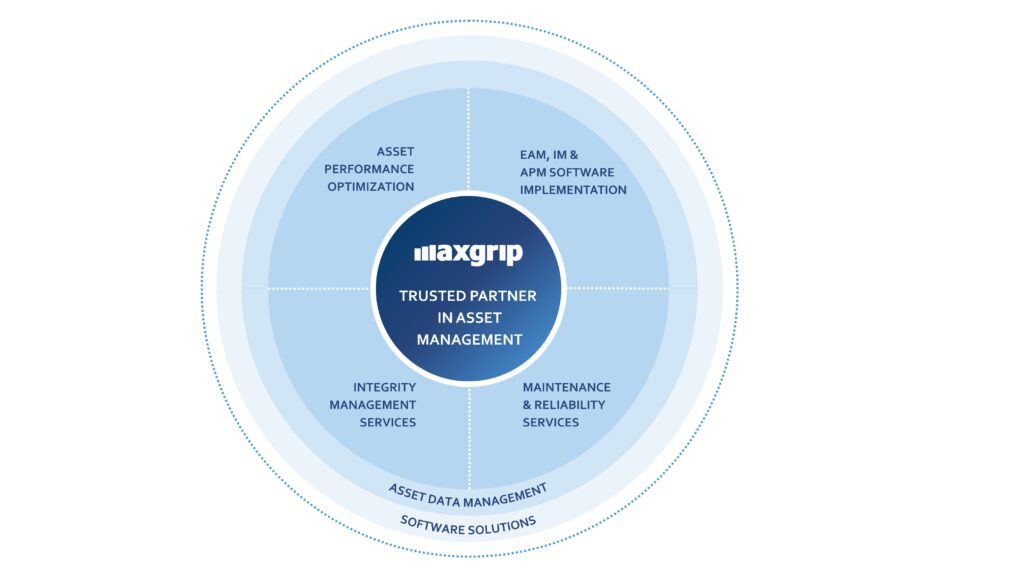
MaxGrip has long positioned itself as a trusted partner in asset management, with four core service domains: Asset Performance Optimization, EAM, IM and APM Software Implementation, Maintenance and Reliability Services, and Integrity Management Services.
However, our global experience and the challenges our clients face have made one conclusion clear: without a robust data foundation and an integrated software landscape, improvement initiatives remain isolated and difficult to sustain.
That is why we have explicitly strengthened our model with two foundational elements: Asset Data Management and Software Solutions. Asset Data Management is a strategic enabler. Clean equipment structures, standardized failure reporting, clear ownership, and reliable asset histories are prerequisites for effective maintenance and digitalization. As Tjeerd de Jong of Rijkswaterstaat warned during the conference, without a solid data foundation, asset managers risk drowning in data rather than gaining insight.
Software solutions are not about deploying platforms in isolation. They are about designing and integrating the right technology ecosystem so that EAM, APM, integrity systems, and planning tools reinforce each other and deliver measurable operational results.
Equally important is structured change management. New systems and new data standards only deliver value when people adopt them. Embedding new workflows, clarifying roles, aligning incentives, and training teams are critical steps in turning strategy into execution. Without change management, even the best technology remains underutilized.
From insight to execution
A recurring theme in the Verdantix discussions was the need to shorten insight-to-action cycles. Performance data is widely available, but translating it into timely decisions remains a challenge. Maintenance and operations often work in silos, and corporate asset strategies are not always consistently embedded across sites.
Operational agility requires standardized workflows, clear decision rights, and risk-based maintenance strategies supported by reliable asset data. AI-enabled planning can accelerate response times, but only when built on robust processes and data discipline. The objective is not more dashboards, but a connected system where strategy, data, software, and execution reinforce each other.
Total Cost of Ownership as a steering principle
At iMaintain, Total Cost of Ownership was discussed as a daily steering principle rather than a financial calculation after the fact. TCO means continuously balancing risk, reliability, sustainability, and long-term asset health within financial constraints.
In many sectors such as water and energy, continuity is critical. Corine Hoogenbosch of water authority Waternet emphasized that certain risks are simply unacceptable, regardless of cost. At the same time, a large share of budgets is allocated to sustaining existing assets, leaving limited room for new investments. This forces difficult prioritization decisions.
Historically, redundancy was often the default response to risk. Today, organizations are reconsidering that approach. Reliability improvement, predictive maintenance, lifecycle planning, and structured obsolescence management can provide a more balanced and sustainable alternative. That shift requires confidence in data, strategy, and systems.
AI as an enabler
Workforce shortages are accelerating digital adoption. Henk-Jan Bax, CTO at RET, described the availability of skilled personnel as a key driver for automation. AI can help technicians access knowledge faster and support prioritization. However, its effectiveness depends entirely on reliable asset data and clear processes.
At MaxGrip, we apply AI pragmatically, embedding it where it enhances decision making and can significantly increase time to value, always grounded in structured data and proven methodologies.
Strengthening asset performance in a changing environment
Since 1997, MaxGrip has grown into a global consultancy serving leading organizations in Manufacturing, FMCG, Pharmaceuticals, Power, Oil and Gas, and Water and Wastewater. Across all sectors, the operating environment is becoming more demanding. Supply chains are less predictable, workforces are under pressure, assets are aging, and digital expectations continue to rise.
In this context, resilience and agility depend on strong foundations. That is why Asset Data Management and Software Solutions are explicitly integrated into our portfolio model. Not as additions, but as structural requirements for sustainable performance improvement.
Lasting asset performance is not achieved by implementing the next tool. It requires a connected system of reliable data, integrated software, disciplined processes, and committed people. Organizations that invest in these foundations are better positioned to adapt, prioritize effectively, and maintain control in an increasingly complex environment.
Sources:
- Vantage Industrial Asset Management Council: December 2025 Key Takeaways
Get Inspired

Learn how to explain asset management in clear business terms that resonate with non technical stakeholders. Discover why cross functional understanding, cultural alignment, and practical communication are critical for improving reliability, safety, and performance.

Many organizations invest in EAM and APM with high expectations, yet struggle to turn digital intent into real operational results.
MaxGrip CEO Mark Mulder explains why clean asset data, integrated EAM and APM software, and strong processes matter more than ever in 2026.