A leading power generation company operates three plants, each equipped with its own warehouse. The company encountered major spare parts management issues due to inconsistent naming conventions and poor inventory visibility. As part of their Asset Performance Management Improvement roadmap, they aimed to establish Bills of Materials (BoMs), but a lack of standardized data and inventory awareness hindered progress.
Ambitions: Establish Bills of Materials
In the process of establishing comprehensive BoMs, the company recognized a general lack of awareness regarding their inventory, which posed several challenges:
- Inconsistent Item Naming: Item names varied significantly, with some being detailed and others labeled generically as "filter," "coupling," or "lubricant," lacking sufficient description.
- Duplicate Items: The item master likely contained duplicates under different names, making it difficult to ascertain the true on-hand quantity of identical items.
- Obsolete Items: Some items were not linked to any asset and had become obsolete.
Without consistent naming and accurate BoMs, maintenance planning and reliability strategies suffered. The company struggled to make informed stocking decisions, set appropriate min-max levels, and determine part criticality—highlighting the urgent need for standardized naming and better data management.
Approach: Development of Naming Standard
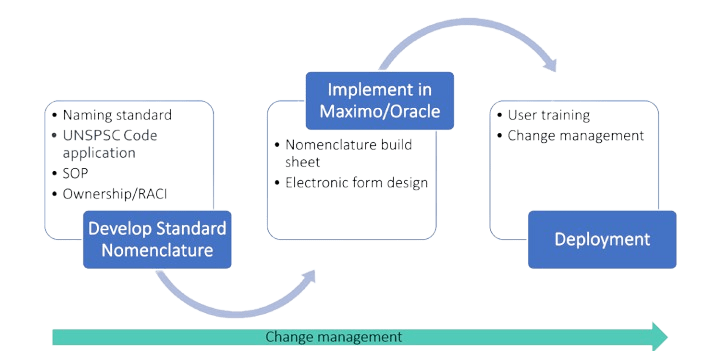
To address these challenges, MaxGrip collaborated with the company to develop a naming standard for over 90% of their spare parts. During this process, the supply chain team requested the application of UNSPSC codes to the nomenclature to facilitate further grouping and analysis of inventory data.
To ensure the new system was embedded and sustainable, our consultants developed Standard Operating Procedures (SOPs), including a RACI chart and guidelines for naming future spares. The nomenclature was compiled into a build sheet, implemented in their ERP/EAM system, and mapped to an electronic spare part creation form. This system was deployed company-wide, accompanied by user training.
One key component often overlooked when new processes and systems are introduced in the organization is change management. Who would be impacted by the new way of working, and how? For this project, MaxGrip identified stakeholders, planners, and warehouse personnel, and maintained constant communication with them. Their feedback was integral to ensuring the system met their expectations, facilitating smooth adoption of the new processes.
As a result, the company quickly transitioned to the new system, achieving greater inventory visibility, reduced duplicate items, and more accurate Bills of Materials (BoMs), all contributing to improved maintenance planning and cost control.
Results: Streamlined Maintenance Planning and Improved Operational Efficiency
Implementing standardized naming conventions yielded several positive outcomes. By standardizing spare parts naming and improving inventory management, the power generation company enhanced maintenance planning, operational efficiency, and asset reliability. An electronic form with dropdown menus was introduced for part creation, enhancing consistency and efficiency. Additionally, the new system provided a scalable framework adaptable to future needs.
Benefits realized:
- Rapid User Adoption: Due to effective change management and stakeholder engagement, users quickly embraced the new system.
- Enhanced searchability: spare parts data being easier searchable led to greater efficiency in both maintenance and operations, allowing teams to quickly locate and identify the correct components.
- Improved consistency: The ease of naming spare parts simplified data management and reduced confusion when handling inventory.
- Reduced errors: accurate and reliable data resulted in less errors.
- Optimized inventory levels: avoiding overstocking and ensuring availability of critical parts when needed led to a reduction of inventory costs.
Together, MaxGrip helped the company streamline maintenance planning, improve operational efficiency, and strengthen their overall asset management strategy.
Get Inspired
Discover how effective root cause analysis can boost maintenance reliability and performance. Learn practical strategies to enhance your operations today.

Many organizations invest in EAM and APM with high expectations, yet struggle to turn digital intent into real operational results.

MaxGrip CEO Mark Mulder explains why clean asset data, integrated EAM and APM software, and strong processes matter more than ever in 2026.