
This article is for maintenance managers, reliability engineers, and operations leaders in asset-intensive industries. Spare parts management is a critical discipline that directly impacts maintenance efficiency and operational reliability. Effective spare parts management is essential for maintaining system reliability, operational readiness, and cost-efficiency. It strikes a balance between excessive stock and insufficient inventory to control costs, ensuring that the right components are available when needed most.
Definition: Effective spare parts management balances the high cost of equipment downtime against the expense of carrying excess inventory. It minimizes downtime, controls inventory costs, and improves operational efficiency.
We cover five common challenges in spare parts management and practical solutions for each. By understanding and addressing these challenges, organizations can optimize their spare parts processes and achieve better business outcomes.
Introduction to Spare Parts Inventory
Despite its critical role in maintenance efficiency and operational reliability, spare parts management is often an overlooked discipline. Many asset-intensive companies, especially those operating in heavy industry sectors, find themselves in a paradox: storerooms overflowing with parts, yet still facing delays due to missing critical components. Managing critical parts is essential for maintaining operational continuity and preventing equipment failures.
Effective spare parts management is a strategic approach to controlling risks associated with equipment downtime, minimizing the impact of asset failure through effective spare parts management, ensuring optimal spare parts inventory, and maintaining business operations efficiently.
Effective spare parts management minimizes downtime, controls inventory costs, and improves operational efficiency. Effective parts management ensures that the right components are available when needed most.
The result of poor management is costly downtime, frustrated teams, and unnecessary capital locked up in inventory. Below, we highlight five challenges that we encounter regularly and illustrate solutions based on real-world examples.
Challenge 1: Inaccurate and Inconsistent Spare Parts Data Impacting Inventory Accuracy
The Problem
One of the most fundamental issues in spare parts management is poor data quality. Inconsistent naming, duplicate entries, and missing details make it difficult to manage inventory effectively or plan maintenance with confidence.
Maintaining accurate BOMs (Bills of Materials) is essential for efficient spare parts management, inventory control, and maintenance scheduling. Real-time updates to BOMs help prevent downstream issues that can arise from outdated or incorrect information.
Real-World Example
In one power generation company, maintenance teams at three different plants struggled to ensure the right spare part was available at the right time and place for maintenance or repair. Although the storerooms were well-stocked, inconsistent naming conventions across sites meant that identical components were listed under different names—or worse, duplicated entirely. These discrepancies caused delays, confusion, and repeated purchases of parts that were already available.
The issue stemmed from unstructured data practices. Without standardized naming rules or clear ownership of spare parts information, it became impossible to get a reliable overview of the inventory.
Solution
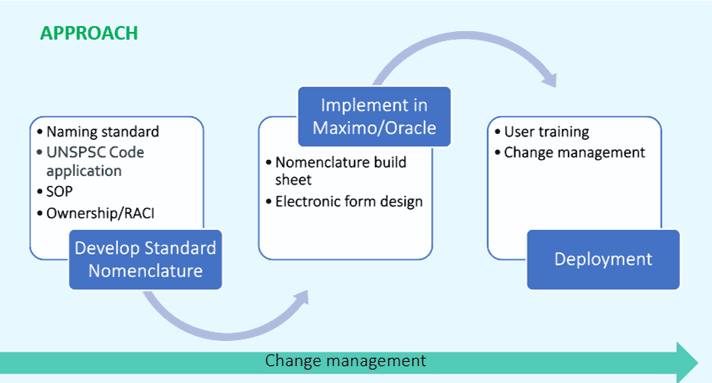
To fix this, we helped the company establish a structured data foundation:
-
Standardizing naming conventions
-
Implementing uniform data entry templates
-
Assigning data governance roles (via SOPs and RACI charts)
-
Regularly auditing their inventory data
Results:
-
Search times dropped
-
Purchasing errors decreased
-
Inventory levels could finally be optimized with confidence
With data quality addressed, the next challenge is ensuring inventory records are trustworthy.
Challenge 2: Inventory Records that can't be Trusted
The Problem
When the data is unreliable, so is the inventory—and that affects everything from planning to procurement. In another case, an FMCG client found that stock levels in their EAM system frequently didn't match reality. These issues often stemmed from inventory discrepancies between physical and digital records. Some parts appeared available but couldn't be found in the storeroom; others were physically present but not registered digitally.
This mismatch led to operational headaches: urgent orders, missed preventive maintenance windows, and lost productivity.
Solution
We rolled out real-time inventory updates using barcode scanning via mobile devices. This technology helped track inventory items more accurately and reduced discrepancies. Technicians could immediately register part usage and movements during their work, removing the lag between physical stock and digital records. A cycle counting program was also introduced to proactively catch discrepancies and keep the data clean.
Steps Implemented:
-
Introduced barcode scanning for real-time inventory updates
-
Enabled technicians to register part usage and movements instantly
-
Launched a cycle counting program for proactive discrepancy detection
Results:
-
Restored trust in the system
-
Provided the planning team with a reliable foundation for decision-making
With inventory records now reliable, the next challenge is finding the right balance between stockouts and overstocking.
Challenge 3: Stockouts and Overstocking: a Balancing Act
Striking the right balance between having too few and too many spare parts is notoriously difficult. One oil and gas company experienced frequent stockouts for new equipment, driven by an overreliance on OEM recommendations. The result: unexpected downtime and over $100,000 in emergency purchasing. Meanwhile, another company in the energy sector faced the opposite problem—years of overstocking had filled their warehouses to capacity, tying up millions in capital.
In both cases, the solution lay in shifting from a supplier-driven to a reliability-centered inventory strategy. By integrating spare parts analysis into broader reliability studies, the organizations were able to define clear Stock/No-Stock rules, apply plant-specific logic, and set appropriate min/max levels for critical components.
For the overstocked sites, structured warehouse improvements played a big role. ABC classification helped prioritize by value, while 5S principles and barcode scanning brought visibility and order to inventory operations. These actions freed up working capital, reduced emergency purchases, and established a leaner, more responsive inventory.
In both cases, moving toward a reliability-centered inventory strategy made the difference. By integrating spare parts analysis into their broader reliability studies, these organizations could define clear Stock/No-Stock rules, appropriate min/max levels, and prioritize spares based on risk and criticality—not just what suppliers suggested.
For the overstocked sites, we also helped apply structured methods like ABC-X matrices, 5S principles, and barcode systems to streamline warehouse operations and eliminate excess. The gains were both financial and operational: freed-up working capital, fewer emergency orders, and a leaner, more resilient inventory.
Challenge 4: Slow-Moving and Obsolete Inventory
Warehouses often become home to parts that are rarely, if ever, used. These slow-moving or obsolete items take up valuable space, tie up budget, and make it harder to manage inventory effectively. Yet deciding what should stay and what should go isn't always straightforward.
It's tempting to clean house and remove anything slow-moving, but not all rarely used parts are redundant. Some are business critical spares, needed only in exceptional (but high-risk) scenarios. Without a structured criticality assessment, those vital parts may be misclassified and removed—putting safety or uptime at risk when it matters most.
That's why we recommend complementing an ABC-XYZ analysis with a VED criticality tagging:
- V: Vital spares—unavailability causes complete shutdown or safety/environmental hazard
- E: Essential—unavailability causes performance degradation or partial shutdown
- D: Desirable—unavailability has minor or no immediate impact
Using this approach, one client we worked with reviewed 1,500 line items, identified over $30M in obsolete stock, and freed up space for the parts that truly mattered.
Spare parts optimization isn't just a matter of clearing shelves. It's a strategic decision to protect your operations where it counts most. Putting them together—ABC (value), XYZ (movement), and VED (criticality)—and you get a clearer picture of what's worth keeping or discarding.
Challenge 5: Ineffective Kitting Practices
Even when the right parts are in stock, inefficient maintenance kitting can undermine performance. A global healthcare company found that maintenance tasks were routinely delayed because kits were incomplete or poorly organized. Technicians lost time searching for missing components, and in some cases, used incorrect parts—leading to further downtime and costly rework.
To address this, we worked with the organization to define kit contents per job type, integrate kitting workflows into their EAM system, and create dedicated staging areas with clear labeling. By streamlining parts issuance as part of the work order process, the company maintained inventory accuracy and facilitated efficient distribution of parts. Maintenance and warehouse teams were trained to sustain the process, and KPIs like kit accuracy and technician efficiency were introduced to monitor progress.
The result was a streamlined maintenance workflow with fewer delays, more predictable execution, and better use of technician time.
Conclusion: the Value of an Integrated Strategy
Each of these five challenges—data issues, inaccurate inventory, stock imbalances, obsolete parts, and inefficient kitting—may seem separate at first glance. But in reality, they're deeply interconnected. Poor data leads to poor planning. Inaccurate records fuel stockouts. Overstocking hides obsolescence. And without structure, even the best-prepared kits fall apart.
This is why we advocate for a fully integrated spare parts management strategy—one that treats data, process, systems, and people as part of a unified whole. By addressing spare parts challenges across all dimensions, companies not only boost maintenance efficiency but also gain more control, more agility, and better return on asset investments.
Maintenance Team Optimization
Optimizing maintenance teams is a critical component of effective spare parts management. Maintenance teams are on the front lines, responsible for identifying, requesting, and installing spare parts—so their efficiency directly impacts equipment downtime and maintenance costs. To get the most from your maintenance teams, it's essential to invest in targeted training on inventory management, spare parts identification, and equipment maintenance procedures.
Adopting a data-driven approach to maintenance scheduling and spare parts procurement can help teams anticipate needs, track usage history, and spot usage trends, all of which contribute to smarter inventory decisions and improved inventory accuracy. Leveraging technologies such as ERP's warehouse functionality and scanning functionality allows maintenance teams to quickly locate and issue the right parts, reducing errors and minimizing delays.
Implementing a comprehensive parts management program—including regular inventory audits and analysis of usage frequency—enables maintenance teams to maintain optimal inventory levels and reduce unnecessary maintenance costs. By empowering maintenance teams with the right tools, training, and data, organizations can improve overall productivity, minimize equipment downtime, and ensure that the right spare parts are always on hand to keep operations running smoothly.

Get Inspired

Industrial transformation is shifting from digital ambition to measurable performance. The winners will be those who anchor technology in strong maintenance, reliability, and asset performance fundamentals.

Choosing the best maintenance strategy for your organization is a constant trade-off between risk mitigation and cost savings. Selecting the right mix of corrective, preventive and predictive maintenance is crucial for asset reliability, operational efficiency, and financial sustainability.

Join this pre‑event webinar ahead of The Reliability Conference (TRC) to explore four critical reliability challenges facing water utilities today—from data quality and compliance pressure to workforce transitions and modernization decisions.